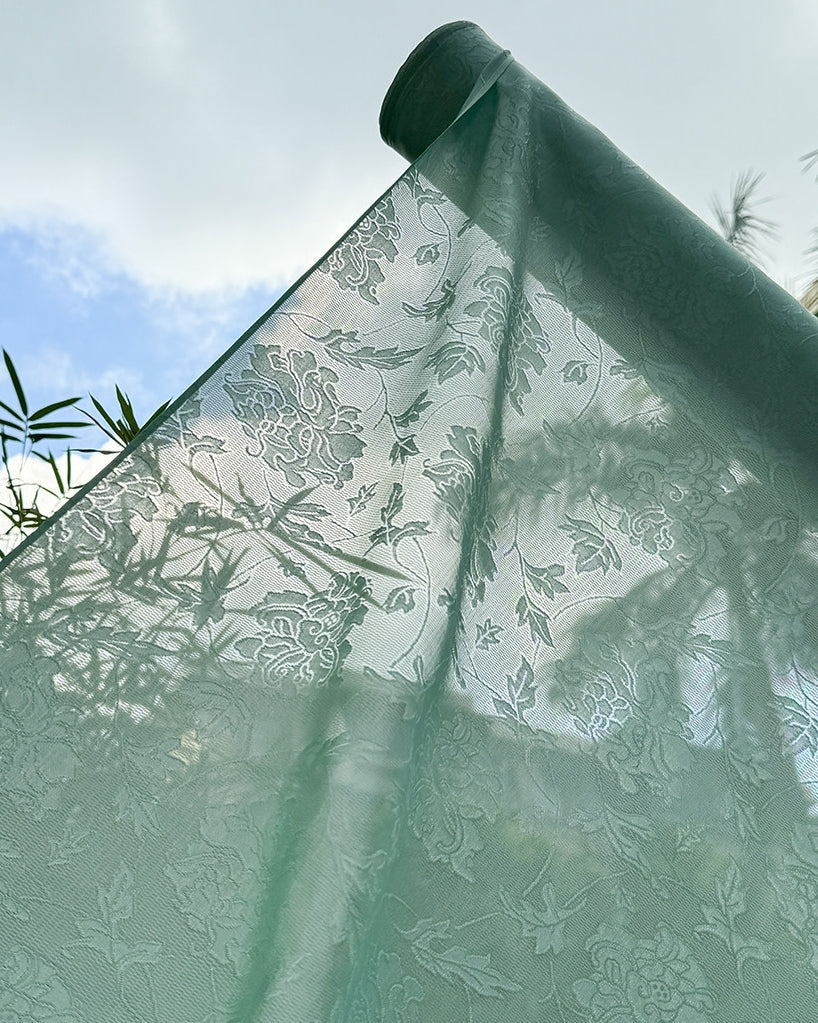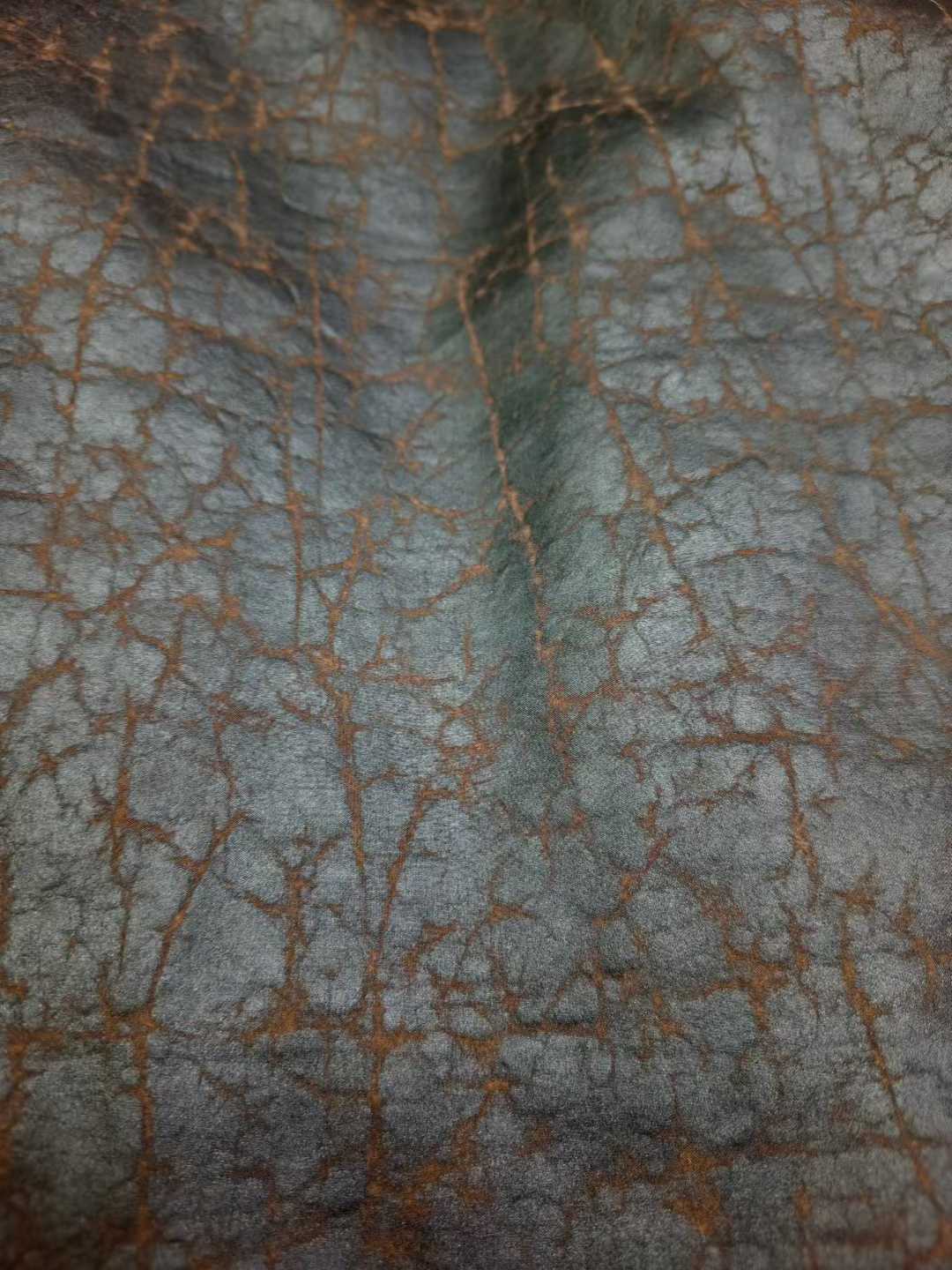
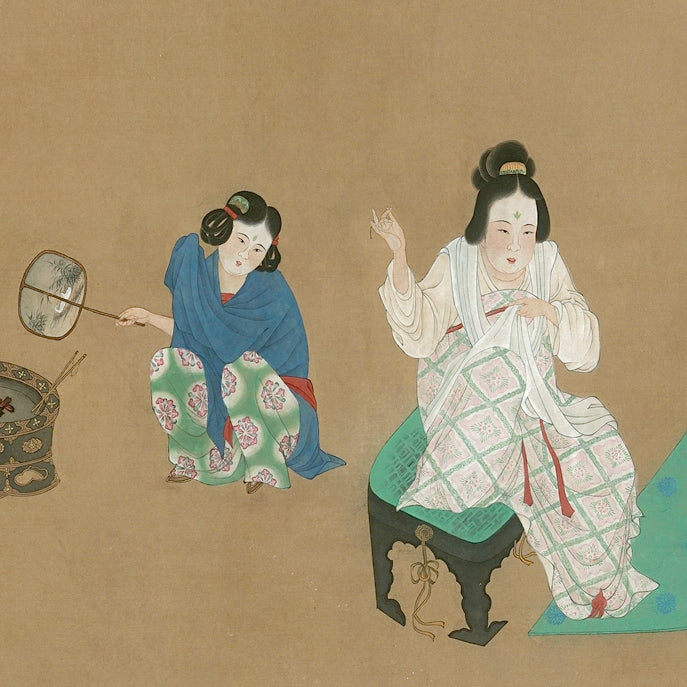

Long before synthetic dyes, Chinese dyers drew color from roots, leaves, flowers, bark and fruit. Indigo blues, madder reds and the yellows of pagoda tree buds became part of a rich textile tradition, shaped by the relationship between plant materials, fibers and dyeing techniques.
At CROSE, this tradition offers a way to look more closely at cloth and color. The following guide explores 19 natural dye materials used in plant-dyeing practice, pairing each material with fabric swatches and an introduction to its use.
The swatches are visual references. Fiber, dye concentration, mordants, temperature and repeated dyeing can all affect the final shade. A color palette shows what a particular sample looks like; it does not, by itself, show how that color will perform in use.
Indigo
The history of indigo dyeing can be traced back to the Warring States period. Indigo plants are used to make dye and include woad, Chinese indigo, true indigo and Assam indigo. The preparation methods include soaking and fermenting the plants, the European woad-ball method, and the mysterious “Dong dyeing” technique of Guizhou. The indigo paste we commonly use is made from Assam indigo by the soaking method. Indigo dyeing is also a distinctive process: unlike most other plant dyes, which use mordant dyeing, it uses reduction. The dye is reduced to a dark-green dye liquor. When the material is lifted out of the vat it is green, and exposure to air oxidizes it to indigo blue. This is the complete oxidation–reduction process of indigo dyeing.

Sky Blue
Mountain Shadow
Indigo
Midnight
Raven Blue
Ink Black
Method: Indigo dyeing / Fabric: Cotton
Shades, left to right, top to bottom: Sky Blue / Mountain Shadow / Indigo / Midnight / Raven Blue / Ink Black

Gardenia
The plant material used for gardenia dyeing is gardenia flowers. Also known as yellow gardenia and mountain gardenia, it is an evergreen shrub in the madder family. Gardenia was one of the most widely used yellow dyes before the Qin and Han dynasties. Its fruit contains the ketone substance gardenia yellow pigment, as well as crocin and other substances; the substance used for yellow dyeing is crocetin. The Ceremonial of the Han Palace records: “The dye garden produces gardenia and madder for the imperial wardrobe.” This shows that gardenia was used to dye high-grade clothing at that time.

No mordant
Alum
Copper sulfate
Iron sulfate
Method: Boiling / Fabric: Cotton
Mordant results, left to right, top to bottom: None, alum, copper sulfate, iron sulfate
Sappanwood
The dried heartwood of sappanwood, a plant of the genus Caesalpinia in the legume family, was known in ancient times as sufang. It is an important red dye material, and people have used it for dyeing for thousands of years. It is one of the most common materials for red plant dyeing, with a high color concentration, good coloring power and vivid shades. Sappanwood dye is also highly sensitive to changes in acidity. Different external conditions and methods of treatment produce many variations, making both solid-color dyeing and tied patterns well worth exploring.

No mordant
Alum
Copper sulfate
Iron sulfate
Method: Boiling / Fabric: Cotton
Mordant results, left to right, top to bottom: None, alum, copper sulfate, iron sulfate
Safflower
Safflower belongs to the genus Carthamus in the daisy family and is an annual or biennial herb. It is also known as huanglan, honglan, honglanhua and caohonghua. Originating in Egypt, it later reached northwestern China through India and Central Asia, and entered the Central Plains during the Han dynasty. Safflower contains both red and yellow pigments and can be used to dye red and yellow textiles. The red produced by safflower is called “true red” or “scarlet.” To obtain these colors, the red pigment must be repeatedly extracted and purified, and the fabric or silk threads sometimes need to be dyed six or seven times or more.

No mordant
Alum
Copper sulfate
Iron sulfate
Method: Kneading / Fabric: Bast-fiber fabric
Mordant results, left to right, top to bottom: None, alum, copper sulfate, iron sulfate
Madder
Madder is one of the earliest red plant dyes used by humankind. It is also known as ranjiangcao, xueqiancao, xuejianchou, qiancao, diximu, huoxuedan, tudanshen and hongneixiao. In China, India, Egypt, Persia and ancient Rome, madder roots were used at different times to dye wool, cotton, bast fibers, leather and silk. By the Shang and Zhou dynasties, madder had become a principal red plant dye. Madder is a multicolored mordant dye: different colors can be obtained by mordanting with different metal salts.

No mordant
Alum
Copper sulfate
Iron sulfate
Method: Alcohol extraction / Fabric: Cotton
Mordant results, left to right, top to bottom: None, alum, copper sulfate, iron sulfate
Pomegranate Peel
Pomegranate peel is the fruit skin of the pomegranate, a plant of the pomegranate family. It is also known as pomegranate shell, sour pomegranate peel or sour pomegranate skin. To prepare it, the fruit is collected in autumn when it is ripe and has split open at the top. The seeds and inner partitions are removed, and the peel is cut into sections and dried in the sun or over a gentle heat. It can be used medicinally. As a plant dye, it is usually classified in the yellow color family.

No mordant
Alum
Copper sulfate
Iron sulfate
Method: Boiling / Fabric: Cotton
Mordant results, left to right, top to bottom: None, alum, copper sulfate, iron sulfate
Onion Skins
Onion skins are often casually discarded in the kitchen, but these discarded skins can also be used as a dye material. They are an economical choice for dyeing. Yellow onion skins tend to produce yellower colors and, under certain conditions, can produce a rich golden yellow with alum. Purple onion skins tend to produce darker colors and, under certain conditions, can produce a dark green with iron sulfate.

No mordant
Alum
Copper sulfate
Iron sulfate
Method: Boiling (purple onion) / Fabric: Cotton
Mordant results, left to right, top to bottom: None, alum, copper sulfate, iron sulfate
Chinese Gallnuts
Also known as baichongcang, baichongjian and beizi, Chinese gallnuts are distinctive galls formed by parasitic aphids on Chinese sumac. In traditional Chinese medicine, they are used for their astringent and antibacterial properties. Those harvested in June and July are called “belly galls,” while those harvested in August and September are called “horn galls.” Chinese gallnuts were one of the principal plant materials used for black dyeing in ancient times and can produce black and grey shades of different depths. Besides serving as a textile dye in ancient times, they are also a material used in hair dyes and modern blue-black fountain-pen ink.

No mordant
Alum
Copper sulfate
Iron sulfate
Method: Boiling / Fabric: Cotton
Mordant results, left to right, top to bottom: None, alum, copper sulfate, iron sulfate
Black Tea
Black tea takes its Chinese name, “red tea,” from the red color of its infusion and brewed leaves. Tea polyphenols contain many phenolic hydroxyl groups, which have an affinity for the molecules of protein fibers. This is why tea can dye cloth. Tea is also popular because it is easy to obtain. Compared with other varieties of tea, black tea produces a richer color when used for dyeing.

No mordant
Alum
Copper sulfate
Iron sulfate
Method: Boiling / Fabric: Cotton
Mordant results, left to right, top to bottom: None, alum, copper sulfate, iron sulfate
Shuliang
Shuliang is a climbing plant of the yam genus in the yam family and can grow up to 20 meters long. Its tubers have rough, uneven, dark-brown skins and are about the size of taro. Widely distributed in southeastern China, it provides a uniquely valuable resource for the thousand-year-old traditional craft of xiangyunsha. In the past, shuliang was used not only to dye clothing and yarn, but also extensively to dye fishing nets woven from cotton and bast fibers. This was mainly because it is rich in tannic acid and gum, which strengthen the fibers after dyeing and help prevent seawater from corroding the net fibers. Our ancestors also used shuliang to tan leather, reportedly in considerable quantities.

No mordant
Alum
Copper sulfate
Iron sulfate
Method: Boiling / Fabric: Cotton
Mordant results, left to right, top to bottom: None, alum, copper sulfate, iron sulfate
Gromwell
Gromwell is a perennial herb of the genus Lithospermum in the borage family. It was first recorded in the Divine Farmer’s Classic of Materia Medica, where it was classified as a middle-grade medicinal herb. Its roots are straight, cylindrical and slightly curved, with dark reddish-purple outer skins. As an ancient dye plant, gromwell was already widely used for dyeing in the state of Qi during the Spring and Autumn period. Qi produced gromwell abundantly, and Duke Huan of Qi liked to wear purple, so “the whole country wore purple.” Older gromwell gives better results. The roots are the part used, and the dyeing methods include kneading and alcohol extraction.

No mordant
Alum
Copper sulfate
Iron sulfate
Method: Alcohol extraction / Fabric: Cotton
Mordant results, left to right, top to bottom: None, alum, copper sulfate, iron sulfate
Persimmon Tannin
Dyeing with persimmons has a long history. As late as the end of the 1970s, some elderly people in Xuzhou were still using local astringent persimmons to extract persimmon tannin and dye cloth for clothing. Persimmon dyeing differs from other types of plant dyeing: it does not fear sunlight, and the color becomes deeper with more sun exposure. This is because persimmon tannin contains abundant tannins—the source of the astringency we taste in persimmons. These substances oxidize more readily in sunlight, developing the color.

Alum
Sodium carbonate
Method: Persimmon dip-dyeing / Fabric: Traditional woven cloth
Treatment results, top to bottom: Alum, sodium carbonate
Lotus Seed Shells
Lotus seeds are produced abundantly in Hunan, Hubei, Jiangxi, Fujian, Zhejiang and other parts of China. Processing them creates a large quantity of a by-product: lotus seed shells. Because the shells are hard and thick, their rate of use is relatively low. In fact, lotus seed shells were used for dyeing in rural areas in the past. Black cloth was once called “baotouqing” or “zuqing,” and lotus seed shells were among the dyes often used for this purpose. Boiling them together with cloth, alum, iron sand and other materials produces cloth close to deep black.

No mordant
Alum
Copper sulfate
Iron sulfate
Method: Boiling / Fabric: Cotton
Mordant results, left to right, top to bottom: None, alum, copper sulfate, iron sulfate
Black Soybean Hulls
Black soybean hulls, also known as black soybean coats, are the seed coats of black soybeans, a leguminous plant. Their outer surfaces are brown-black or black, and they are rich in anthocyanin pigments. People have used them to dye hair for more than a thousand years. In the Tang dynasty, Sun Simiao’s Essential Formulas Worth a Thousand Gold Pieces recorded that a concentrated decoction of black soybeans boiled with vinegar could turn hair black. Red pigment can also be extracted from anthocyanins. Ancient Chinese medical texts record their use as a raw material for rouge, along with hollyhock flowers, double-petaled pomegranate flowers and sappanwood, from which natural red pigments could be extracted. They are also a relatively common plant dye material today.

No mordant
Alum
Copper sulfate
Iron sulfate
Method: Boiling / Fabric: Cotton
Mordant results, left to right, top to bottom: None, alum, copper sulfate, iron sulfate
Mugwort
Mugwort is a perennial herb or somewhat shrub-like plant found almost throughout China. It is closely connected with our daily lives: during the Dragon Boat Festival, people always place mugwort in their homes to “ward off evil.” The whole plant can be used medicinally and is also a good food ingredient. Mugwort floss is one of the main raw materials for making seal paste, and mugwort can also be used as a natural plant dye.

No mordant
Alum
Copper sulfate
Iron sulfate
Method: Boiling / Fabric: Cotton
Mordant results, left to right, top to bottom: None, alum, copper sulfate, iron sulfate
Japanese Knotweed
Japanese knotweed is a perennial herb of the knotweed genus in the buckwheat family. It prefers a warm, moist climate, has a well-developed root system, and is highly resistant to drought and cold. It is a yellow dye material and can also be used medicinally.

No mordant
Alum
Copper sulfate
Iron sulfate
Method: Boiling / Fabric: Cotton
Mordant results, left to right, top to bottom: None, alum, copper sulfate, iron sulfate
Phellodendron Bark
Phellodendron is a deciduous tree with oval, pinnate leaves belonging to the citrus family. It is also known as huangbai, huangboluo, huangboli, huangbo, bomu and bopi. It grows in mountain scrub and is commonly found in northern and northeastern China. Its branches and stems are materials for yellow dyeing. The bark has two layers: the first contains no pigment, so the second layer must be used for dyeing. Phellodendron is a dye material containing alkaloid pigments. Alum mordanting can produce a subdued yellow with a slight green cast. The cultivation and dyeing uses of phellodendron are recorded in Essential Techniques for the Welfare of the People.

No mordant
Alum
Copper sulfate
Iron sulfate
Method: Boiling / Fabric: Cotton
Mordant results, left to right, top to bottom: None, alum, copper sulfate, iron sulfate
Pagoda Tree Buds
These are the flower buds of the pagoda tree, a plant in the legume family. They are harvested when the buds form in summer and dried promptly, with branches, twigs and impurities removed. The buds are rich in a substance called rutin, which has strong pharmacological effects. They have therefore long been an important medicinal material. They can also be made into pagoda-bud tea and wine. According to historical research, China was already using pagoda tree buds as a yellow dye in the Song dynasty. As a precious dye material, they were long reserved for the imperial household. Colorfastness depends on the fabric and dyeing process and should be assessed on the finished textile.

No mordant
Alum
Copper sulfate
Iron sulfate
Method: Boiling / Fabric: Cotton
Mordant results, left to right, top to bottom: None, alum, copper sulfate, iron sulfate
Turmeric
Also known as jianghuang, turmeric is the rhizome of the perennial turmeric plant in the ginger family. It is dug up in winter when the stems and leaves have withered, washed, boiled or steamed until thoroughly cooked, dried in the sun, and stripped of its fibrous roots. It contains curcumin, which can be used for dyeing. Like gardenia, it can produce yellow shades with high brightness and high saturation.

No mordant
Alum
Copper sulfate
Iron sulfate
Method: Boiling / Fabric: Cotton
Mordant results, left to right, top to bottom: None, alum, copper sulfate, iron sulfate
Understanding Colorfastness
Colorfastness describes how well a textile resists color change or color transfer under particular conditions. Resistance to washing, light and rubbing is assessed separately; a fabric can perform differently in each test. Examples include ISO 105-C06 for laundering, ISO 105-B02 for light and ISO 105-X12 for rubbing.
There is no single colorfastness grade for all plant-dyed fabrics. A stated grade needs a test method and a clearly identified sample. Results for one fabric, shade or production batch should not be assumed to apply to another.
This guide presents materials and color references, not product test results. For a specific project, consider the finished fabric’s intended use, care instructions and any available test report.