
Chinese silk is not a single fabric. It is a language of structure, surface, weight, texture, light, and hand feel.
In the classical Chinese textile system, silk fabrics were not named only by fibre content. They were understood by how they were woven, how they moved, how they reflected light, and how they felt in the hand.
This article offers a refined introduction to the 14 classical Chinese silk categories. These names describe different ways of making silk: smooth or textured, dense or open, luminous or matte, fluid or structured.
They also remind us that Chinese silk is more than a material. For thousands of years, it has been part of daily life, ceremony, trade, beauty, and cultural imagination — one of the great textile languages born from ancient China.
The 14 Classical Silk Types
Traditional Chinese silk classification includes fourteen major categories:
- Sha / 纱
- Luo / 罗
- Ling / 绫
- Juan / 绢
- Fang / 纺
- Xiao / 绡
- Zhou / 绉
- Jin / 锦
- Duan / 缎
- Ti / 绨
- Ge / 葛
- Ni / 呢
- Rong / 绒
- Chou / 绸
Some categories describe weave structure. Some describe surface texture. Others describe density, raised pile, decorative pattern, or a particular hand feel.
Together, they form a material language that helps us read silk beyond the modern terms of satin, chiffon, organza, crepe, or velvet.
Sha / 纱 — Gauze Silk
Sha refers to gauze silk.
It is light, open, and breathable, often with a clearer sense of woven structure. In traditional use, Sha is closely connected to airy openwork cloth, where the fabric feels delicate but still organized.
Compared with softer sheer silks, Sha may feel slightly crisper, drier, or more structured. Its beauty lies in the balance between transparency and woven order.
Luo / 罗 — Twisted-Warp Silk
Luo refers to twisted-warp silk, often understood internationally through the language of leno structure.
In Luo weaving, warp threads twist and cross to create stable open spaces within the cloth. The result is light and breathable, but not loose. The openness is held by the structure itself.
Luo belongs to the Chinese jiao jing tradition — a refined twisted-warp method where air, light, and stability are created through the weave.
Ling / 绫 — Twill Silk
Ling refers to twill silk.
It usually carries a subtle diagonal structure, giving the fabric visual rhythm and a more composed surface. Compared with satin, Ling is generally less glossy and more restrained.
Its character is quiet, structured, and elegant.
Juan / 绢 — Fine Plain-Weave Silk
Juan refers here to a fine plain-weave silk category.
It is usually smooth, compact, even, and slightly crisp, with a clean woven surface. In this classical classification, Juan is defined by weave and surface character.
It should not be confused with spun silk. Spun silk is made from shorter silk fibres or silk waste that are spun into yarn. Juan, in this context, is not a short-fibre silk category.
Fang / 纺 — Plain-Weave Silk
Fang refers to plain-weave silk fabrics.
These fabrics are often light, smooth, practical, and softly crisp. They may be used for linings, shirts, summer garments, and everyday silk pieces.
In modern fabric language, some habotai-type silks sit close to this world of light plain-weave silk.
Xiao / 绡 — Sheer Silk
Xiao refers to sheer silk.
It is fine, translucent, and delicate, often softer and more veil-like than Sha. Its beauty comes from clarity, lightness, and quiet transparency.
If Sha feels more structural, Xiao feels more floating.
Zhou / 绉 — Crepe Silk
Zhou refers to crepe silk.
It is usually made with twisted yarns, creating a textured surface and a soft, slightly elastic feeling. The surface may be subtle or more pronounced depending on the weave and finishing.
Crepe de chine and georgette belong close to this wider world of crepe textures.
Jin / 锦 — Brocade Silk
Jin refers to brocade silk.
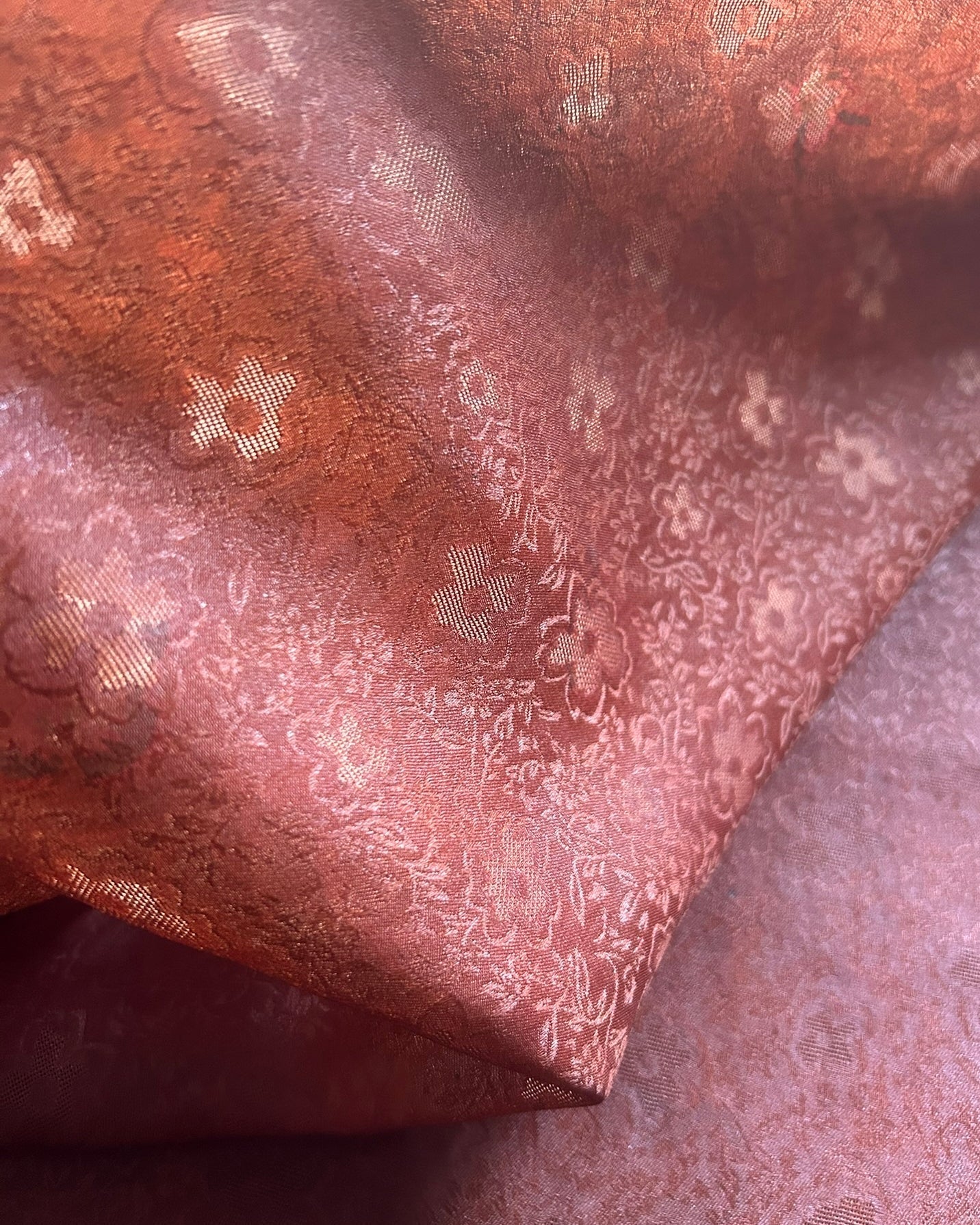
It is known for woven pattern, decorative richness, and a more formal textile language. Unlike printed silk, the pattern in Jin is created through the weaving process itself.
Chinese brocade can carry structure, colour, symbolism, and ornament in the same fabric.
Duan / 缎 — Satin Silk
Duan refers to satin-weave silk.
It is smooth, luminous, and elegant, with a surface that catches light beautifully. The satin structure creates a softer sheen and a more fluid impression than many other weave types.
Modern silk satin and silk charmeuse are the closest international references, though the exact character always depends on weight, density, and finishing.
Ti / 绨 — Heavy Plain or Ribbed Silk
Ti refers to a heavier silk category, often associated with a more substantial plain or ribbed structure.
It may feel stronger, thicker, and more practical than delicate sheer silks. Its character is not about lightness, but about firmness and utility.
In the classical silk language, Ti reminds us that silk was not only used for luminous surfaces. It could also be durable, dense, and structured.
Ge / 葛 — Textured Silk
Ge refers to a textured silk category, often with a slightly coarse, dry, or linen-like feeling.
Compared with smooth satin or fine plain silk, Ge has more surface character. It may feel more rustic, more breathable, and more tactile.
Its beauty lies in restraint and texture rather than shine.
Ni / 呢 — Wool-Like Silk
Ni refers to silk fabrics with a wool-like character.
These fabrics may feel fuller, warmer, or more substantial, with a surface that is less glossy and more matte. The character is closer to soft tailoring or autumn-winter materials than to fluid summer silk.
Ni shows how silk can move beyond the idea of delicacy and become structured, warm, and composed.
Rong / 绒 — Velvet Silk
Rong refers to velvet or pile silk.
Its raised surface gives the fabric depth, softness, and rich light movement. Unlike flat woven silk, Rong catches light through pile, shadow, and touch.
Silk velvet, including patterned or burnout velvet, belongs to this world of tactile surface and quiet richness.
Chou / 绸 — Closely Woven Silk
Chou is a broad silk category.
It often refers to closely woven silk fabrics with a smooth, composed surface. In many contexts, Chou can also be used more generally to describe silk cloth.
Because the term is broad, its exact meaning depends on context. Within the classical category system, it carries a sense of woven density, smoothness, and practical elegance.
A Closer Note on Sha and Xiao
Among the fourteen categories, Sha and Xiao are especially easy to confuse because both can appear light, sheer, and delicate.
The difference is subtle but important.
- Sha / 纱 is closer to gauze silk. It has a more open and structured character.
- Xiao / 绡 is closer to sheer silk. It is usually softer, finer, and more translucent.
Both may be used for light garments, overlays, scarves, and delicate layers. But Sha gives more structure to a sheer surface, while Xiao gives more softness and quiet movement.
The name gives direction, but the fabric still needs to be read through touch, light, density, and finishing.
The Structure Behind the Surface
These classical names remind us that silk is not defined by fibre alone. A satin silk, a crepe silk, a brocade silk, and a twisted-warp silk may all be silk, but they behave very differently.
One may be smooth and luminous. One may be dry and textured. One may be open and breathable. One may hold pattern through complex weaving.
To understand Chinese silk is to look beyond surface beauty and read the structure beneath it — the weave, density, texture, movement, and hand feel that give each fabric its own character.
A Living Language of Chinese Silk
More than five thousand years ago, silk was already being woven on the ancient land of China. From early plain silks and openwork structures to later refinements of Sha, Luo, Ling, Juan, Fang, Xiao, Zhou, Jin, Duan, Ti, Ge, Ni, Rong, and Chou, Chinese silk gradually formed a rare and complete material language — one shaped by fibre, weave, climate, hand, and time.
For centuries, Chinese silk was more than a beautiful fabric. It was one of the great luxuries of the world, travelling through trade, diplomacy, and desire. Alongside porcelain, it carried the imagination of China across continents, entering courts, collections, wardrobes, and interiors far beyond its place of origin.
These fourteen categories are therefore not simply technical names. They are traces of a civilization that understood silk with extraordinary precision: how it could breathe, drape, shine, shelter, soften, adorn, and move with the body. They hold the wisdom of Chinese hands and looms, of daily life and ceremony, of beauty made through structure rather than excess.
At CROSE, we return to this heritage not as nostalgia, but as continuity. The wisdom of Chinese silk once nourished the lives of those who came before us; today, we hope it can continue to nourish modern life — through touch, comfort, movement, and the quiet dignity of natural materials.